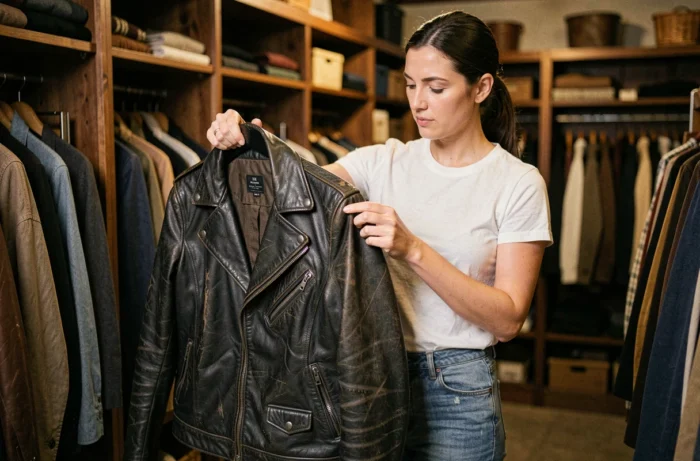
A vintage perfecto is recognized by details that neither the price nor the overall appearance can verify. Closure, leather, label, stitching: each component provides measurable clues. Comparing these markers between an authentic vintage piece and a recent reproduction allows one to decide without collector expertise.
Closures and hardware of a vintage perfecto: what the metal reveals
The hardware is the first element to examine, as it is difficult to reproduce faithfully. The zippers of perfectos made before the 1970s almost systematically use sliders made of solid brass or nickel-plated steel, engraved with the name of the zip manufacturer. Modern reproductions use lighter zamak (zinc alloy), often unmarked or bearing generic markings.
The weight of the slider in hand gives a reliable first indication. An era zip weighs significantly more than a contemporary zip of the same size. The color of the metal also varies: old brass takes on an irregular patina, never uniform.
Snap buttons deserve the same attention. On a vintage Schott perfecto, the snaps carry the markings “Scovill” or “DOT,” two historic American manufacturers. A smooth snap, without inscription, indicates recent manufacturing or a replica. To deepen the analysis of these markers, Style Papers’ fashion tips detail other characteristics associated with period productions.
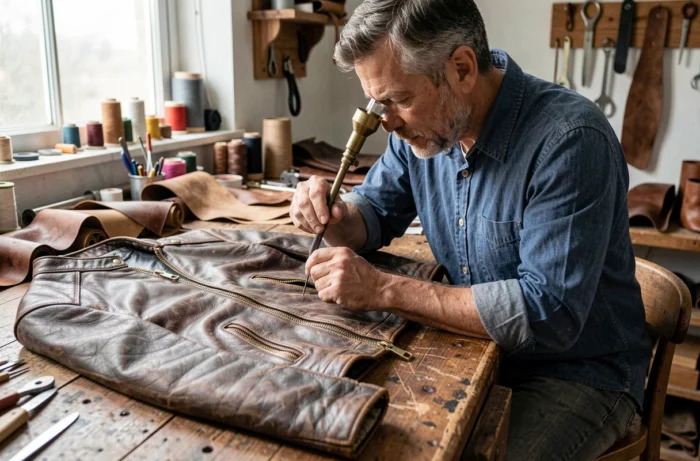
Comparison table: authentic vintage perfecto vs. recent reproduction
| Criterion | Vintage perfecto (pre-1980) | Reproduction or recent piece |
|---|---|---|
| Zipper | Brass or steel, engraved slider (Talon, Ideal, Crown) | Zamak or plastic, generic or absent marking |
| Snap buttons | Engraved Scovill, DOT or United Carr | Smooth or brand marking of the jacket |
| Interior label | Woven fabric, “Made in USA” mention, sometimes lot number | Printed label, “Imported” mention or Asian country |
| Leather | Irregular grain, variable thickness, natural patina | Uniform grain, constant thickness, treated surface |
| Lining | Thick cotton, tartan or quilted flat-stitched | Polyester, quick chain stitching |
| Shoulder cut | Narrow shoulders, high armholes | Wider shoulders, low armholes |
This table summarizes the most discriminating differences. No single criterion is sufficient: it is the convergence of several clues that confirms the authenticity of a piece.
Vintage leather vs. modern treated leather: differences in touch and appearance
The grain of vintage leather is never perfectly regular. Hides tanned in the decades before the 1990s retained more of their natural marks: scars, variations in thickness, slight differences in shade from one panel to another. Contemporary tanneries correct these irregularities through sanding and the application of covering pigments.
To the touch, an old leather that has been used presents a suppleness acquired through use, different from the chemical softness of a new leather softened in a factory. The patina of a true vintage perfecto concentrates on the areas of fold (elbows, closure, lower back), while artificial aging applies a uniform effect across the entire surface.
The smell provides an additional clue. An old full-grain leather emits a dull animal smell, sometimes mixed with wax if the jacket has been maintained. Faux leather or reconstituted leather smells of plastic or solvent, even after several years.
The water drop test
Placing a drop of water on a discreet area of the jacket allows you to distinguish genuine leather from faux leather. Full-grain leather slowly absorbs the drop and leaves a temporary mark that disappears as it dries. Faux leather repels water, which beads on the surface without penetrating.
Labels and interior markings: dating a perfecto by its inscriptions
The interior label of a vintage perfecto provides information that reproductions struggle to imitate. Several elements allow for approximate dating:
- The mention “Made in U.S.A.” on Schott products made before partial relocation indicates American manufacturing, often accompanied by a three-digit model number (613, 618, 118) directly printed on the woven label.
- Labels from before the 1970s use woven thread lettering, not screen printing. The font, size of characters, and background color vary by decade.
- The presence of a union label (ILGWU or ACWA for American productions) allows for situating the piece between the 1940s and the 1990s, depending on the logo used by the union at each period.
However, the complete absence of a label does not disqualify a jacket. Very old perfectos often lost their original label due to wear or intentional cutting by the owner.
Cut and construction: what the silhouette says about the era
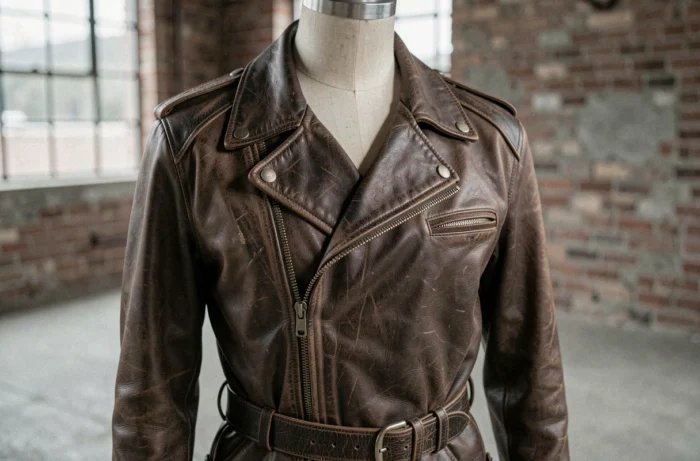
The cut of a perfecto has evolved over the decades, and these structural variations are more difficult to falsify than a logo. Models from the 1950s and 1960s feature high armholes and a narrow build, designed for the hunched position on a motorcycle. Versions after the 1990s widen the build and lengthen the torso to adapt to urban use.
The assembly stitching offers another clue. On older pieces, the leather panels are assembled with double-stitched seams, often in waxed cotton thread. Regular synthetic thread indicates recent industrial manufacturing.
The low belt of the perfecto, when present, fastens with a metal roller buckle on vintage models. Current versions often simplify this detail with a flat buckle or a simple elastic loop.
Each decade has left its signature in the construction of the perfecto. Cross-referencing the analysis of hardware, leather, labels, and cut remains the most reliable method to confirm that a piece is indeed period, and not a skillfully aged reproduction.