Comparing an entertainment preparatory course to a traditional artistic preparatory course is akin to measuring two programs that share a common vocabulary (drawing, visual culture, portfolio) but diverge on almost everything else: duration of commitment, evaluation methods, educational objectives, and the degree of student autonomy after the preparatory year.
Entertainment preparatory course and traditional artistic preparatory course: what the structures reveal
The first difference lies in the very architecture of the curriculum. An entertainment preparatory course like that of ESMA constitutes the first year of a five-year cycle in 3D animation and special effects. The student does not prepare for an external exam: they enter a locked training pipeline, with continuous assessment, a final project, and an oral presentation.
An independent artistic preparatory course, such as Prép’Art or a public preparatory course affiliated with an art school, operates conversely as a standalone year of preparation for exams. The student builds a portfolio, refines their artistic culture, and freely applies to several institutions.
| Criterion | Entertainment preparatory course (type ESMA) | Traditional artistic preparatory course (public or independent private) |
|---|---|---|
| Duration of commitment | Integrated into a 4 to 5-year program | 1 autonomous year |
| Evaluation | Continuous assessment, final project, oral | Portfolio and external exams |
| Main objective | Internal selection towards a specialization (3D animation, VFX, video game) | Admission to one or more art or design schools |
| Technical orientation | Production pipeline, industry software | Plastic fundamentals, artistic culture, personal approach |
| Mobility after the year | Low (integrated curriculum) | High (multiple applications) |
This table highlights a point that training brochures do not always make explicit: choosing an entertainment preparatory course often means committing to a long cycle from the first year. The differences between entertainment preparatory courses and other artistic preparatory courses are less about the content of the first months than about what happens afterward.
Production logic versus exam logic: two distinct educational rhythms
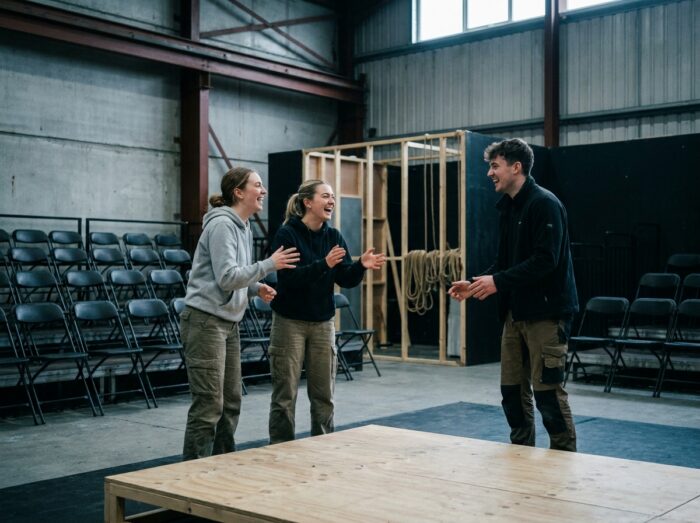
In an entertainment preparatory course, the rhythm resembles that of a studio. Projects follow one another according to short deadlines, with deliverables evaluated for their technical feasibility as much as for their artistic quality. The year prepares students for a functioning based on rapid iterations, typical of animation or video game pipelines.
In a traditional artistic preparatory course, time is structured around the maturation of a personal approach. The student experiments with various mediums (sculpture, printmaking, installation, photography), accumulates cultural references, and learns to defend their choices before an exam jury.
What this concretely changes in daily life
- In an entertainment preparatory course, the student manipulates industry software from the very first weeks and produces deliverables usable in a production chain.
- In a traditional artistic preparatory course, digital works exist but often remain just one tool among others, not the focal point of the training.
- The relationship to failure differs: in entertainment, a failed deliverable is corrected immediately based on technical feedback. In a traditional artistic preparatory course, failure feeds into the plastic research and the construction of a discourse.
This difference in tempo explains why brilliant students in traditional artistic preparatory courses may find themselves destabilized by the industrial pace of an entertainment curriculum, and vice versa.
Fragmented market of artistic preparatory courses: a choice more complex than it seems
The landscape of private artistic preparatory courses is significantly more heterogeneous than that of entertainment preparatory courses. Models coexist without true standardization: one-year preparatory courses, preparatory courses integrated into a school, multidisciplinary preparatory courses covering art, design, cinema, and architecture.
On the public side, the situation is clearer. Public preparatory classes for art and design schools are affiliated with identified institutions, with structured programs. Their access remains geographically limited and subject to selection based on applications.
Entertainment preparatory course: a more focused segment
Entertainment preparatory courses are offered by a limited number of specialized schools (ESMA, Rubika, Gaming Campus, among others). Their positioning is clear: to prepare for technical professions in animated image, video game, or visual effects. The choice is made less on the pedagogical model than on the targeted specialization at the end of the curriculum.
In traditional artistic preparatory courses, the spectrum is broader, making comparisons between institutions more delicate. A student may hesitate between a preparatory course focused on fine arts, a preparatory course in applied arts, and a design preparatory course, three programs with distinct philosophies grouped under the same label.
Continuous assessment versus exam evaluation: the impact on the output profile
The evaluation mode shapes the type of skills that the student develops during the year. In an entertainment preparatory course, continuous assessment encourages a regularity of production similar to that expected in a company. The end-of-year oral resembles a project defense, not a general knowledge test.
In a traditional artistic preparatory course aimed at exams, the student learns to manage the pressure of specific tests. They develop the ability to synthesize their approach in a few minutes before a jury. This know-how is directly transferable to the orals of national higher art schools.
The two models produce different profiles. The first trains students capable of delivering technical work within a constrained timeframe. The second trains candidates capable of defending a personal artistic position before a jury.
The choice between these two formats depends less on a level of competence than on a professional projection. A student attracted to careers in animated cinema or video games benefits from committing early to a technical pipeline. A student who hesitates between several artistic disciplines, or who aims for a national art school, gains more from an open year focused on experimentation and the construction of a discourse.