
When looking for a supplement to relieve a tired liver, the first question that arises in consultation is the legitimacy of the product. Hépaliv, marketed by NutriSolution, specifically targets this niche with a formula containing eight active ingredients aimed at liver detoxification. Before pulling out the credit card, we need to know what healthcare professionals really think about it, beyond the marketing discourse.
Hépaliv and regulatory status: what doctors ask beforehand
A doctor’s first instinct when faced with Hépaliv is to remind its legal framework. Hépaliv has no Marketing Authorization and has not been evaluated by the Haute Autorité de Santé. In practice, this means that the product has not undergone the same effectiveness and safety filters as a prescription hepatoprotective medication.
This point is not trivial. It conditions the entire medical discourse surrounding the product. A general practitioner cannot prescribe it, a pharmacist cannot substitute it for a treatment, and no clinical study has tested the complete formula according to the standards applied to medications. Only certain isolated ingredients (milk thistle, desmodium) have preclinical data or documented traditional use.
Several practitioners surveyed in recent medical summaries adopt a moderately favorable physician opinion on Hépaliv, but only in the context of digestive comfort, never as a treatment for a proven liver pathology.
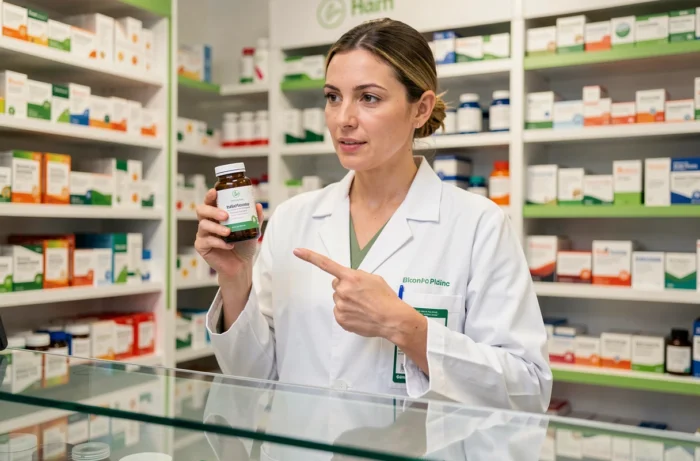
Silymarin and desmodium: the two active ingredients that practitioners know
The formula of Hépaliv is based on eight ingredients, but doctors only seriously comment on two or three. Milk thistle, dosed at 100 mg and standardized to 80% silymarin (i.e., 80 mg per daily dose), is the most documented active ingredient in hepatology. Its traditional use in liver support is recognized, although solid clinical evidence remains limited to studies on silymarin alone, not on multi-ingredient mixtures.
Desmodium, present at 100 mg, has a reputation in African phytotherapy for its effect on liver comfort. Field reports mainly mention a perceived improvement in digestive heaviness and the sensation of a congested liver after meals.
On the other hand, the other components raise more questions than answers:
- Green tea (100 mg, 50% polyphenols) may support metabolism, but some health authorities have reported cases of liver toxicity linked to concentrated catechin extracts, which creates a paradox for a product meant to protect the liver.
- Kola nut (100 mg) provides caffeine, a stimulant that has no direct link to liver function and may be problematic for sensitive individuals or those on treatment.
- Saffron (10 mg) and gymnema (100 mg) are aimed at appetite and sugar metabolism, not liver detoxification in the strict sense.
Only the core ingredients of milk thistle, desmodium, NAC, and betaine truly fall under a hepatoprotective logic. The rest broadens the spectrum towards weight loss, which muddles the product’s positioning in the eyes of practitioners.
Effect on liver enzymes: what clinical feedback shows
This touches on the most sensitive point. Many consumers hope to see their transaminases (ALT, AST) decrease thanks to Hépaliv. Doctors strongly temper this expectation.
A recent summary reporting data from a French multicenter study on mild digestive disorders indicates little to no objectively measured effect on liver enzymes, with a level of evidence rated as low to moderate. The improvement reported by users pertains to subjective feelings: less bloating, smoother digestion, and a feeling of lightness after meals.
This distinction between subjective comfort and biological markers is fundamental. A dietary supplement that improves digestion can indeed be helpful in daily life. But it does not replace a liver assessment, let alone medical monitoring in cases of steatosis, hepatitis, or chronic elevation of transaminases.

Hépaliv price and purchasing conditions: the calculation pharmacists make
The bottle of Hépaliv is priced at 59 euros for a month of treatment (two capsules per day). In a six-month subscription plan, the price drops below 30 euros per bottle. NutriSolution offers a 180-day satisfaction guarantee, which remains rare in the dietary supplement sector.
Pharmacists commenting on this type of product highlight a rarely discussed point: the monthly cost of Hépaliv exceeds that of most milk thistle-based supplements sold in pharmacies. An extract of silymarin alone, in standardized capsules, costs significantly less for an equivalent or even higher dosage.
The question then becomes: are we paying a justified premium for the complementarity of the eight active ingredients, or are we paying for the marketing of a combined formula whose overall effectiveness has not been clinically validated? Feedback varies on this point, but the majority of practitioners recommend comparing before committing to a long-term treatment.
When a doctor advises against Hépaliv
Contraindications are not always clearly stated on sales pages. Doctors identify several situations where Hépaliv should not be taken without prior advice:
- Diagnosed liver pathology (steatosis, cirrhosis, hepatitis): the product is not a treatment and could delay appropriate management.
- Taking medications metabolized by the liver: silymarin may interact with certain cytochromes, altering the effectiveness of common treatments.
- Pregnancy and breastfeeding: no safety data specific to the complete formula is available.
- Caffeine sensitivity: the kola nut makes the product unsuitable for individuals who react strongly to it.
A dietary supplement for the liver can be part of a wellness approach, provided that it is not attributed therapeutic virtues that it has not demonstrated. Doctors who speak about Hépaliv converge on a simple message: lifestyle first, supplement second, and never as a substitute for a diagnosis.