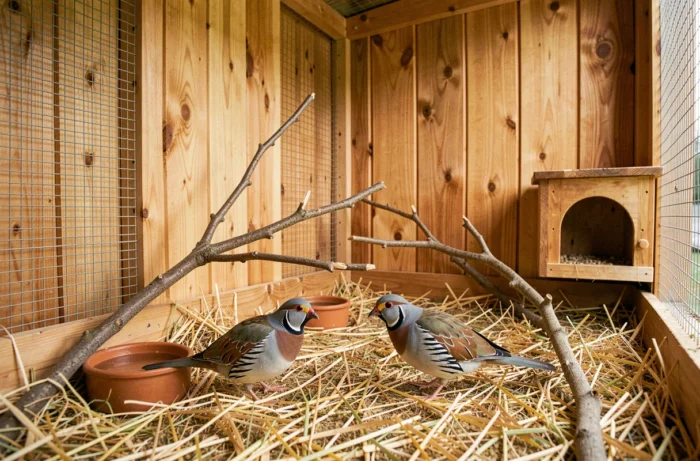
The Chinese quail (Excalfactoria chinensis) is the smallest quail species raised in captivity. Its shelter must meet specific constraints related to its size, ground behavior, and sensitivity to drafts. A poorly designed housing can cause stress, injuries, and respiratory problems, even if the overall dimensions seem adequate.
Usable space in a shelter for Chinese quails: what really matters
Most guides indicate a minimum area per pair, but this information is not sufficient. What determines real comfort is the usable floor space once the equipment is installed. A feeder, a waterer, a refuge, and a sand bath area often occupy a third of the indoor space.
To properly size the shelter, accessories should be arranged on a plan before construction, then measure the remaining space. If the birds have to squeeze between equipment to access their resting area, the shelter is too small, even if its total area seems correct.
Dead corners pose a common problem. Chinese quails live on the ground and move by walking. A corner that is too narrow or a cluttered nook becomes a congestion zone where a dominated bird can get trapped. Favoring simple rectangular shapes, without sharp angles or inaccessible nooks, facilitates cleaning and reduces conflicts.
To delve deeper into this topic, you can set up a shelter for Chinese quails with Animal Passion, which details suitable configurations for this species.
Ventilation and moisture management at ground level
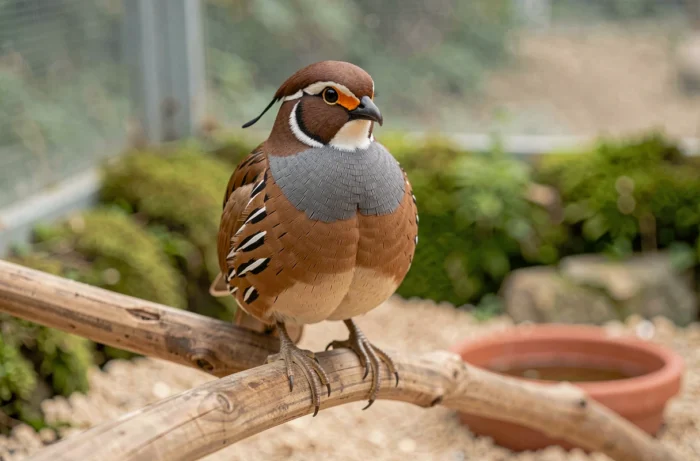
Chinese quails spend all their time on the ground. The air quality at this height differs from that measured at human height. Droppings, wet bedding, and food scraps release ammonia that stagnates in the first few centimeters above the substrate.
The air must circulate without creating direct drafts over the resting areas. The compromise involves openings placed high in the shelter, protected by fine mesh, which allow warm, humid air to escape through natural convection. Low openings, on the other hand, expose the birds to air currents at ground level.
Moisture evacuation in the enclosure
Stagnant moisture is a rapid factor in degrading comfort and health. A wet floor promotes respiratory infections and leg problems. The substrate must be laid on a support that does not retain water.
- A slightly sloped floor (a few degrees is sufficient) allows water leaks from the waterer to flow to one edge rather than stagnate under the bedding
- A removable metal or plastic tray facilitates the complete removal of soiled substrate, whereas a wooden floor absorbs and retains moisture
- A regular partial bedding change, focused on the dirtiest areas (around the waterer and food corner), prevents waiting for a complete cleaning
A dry shelter remains warmer than a damp shelter, even at equivalent temperatures. The evaporation of surface water cools the ambient air, forcing the birds to expend more energy to maintain their body temperature.
Shelter height and vertical takeoff reflex of quails
Chinese quails do not normally fly. However, when frightened, they take off abruptly vertically. This reflex can cause head trauma if the ceiling is rigid and too high.
A low ceiling limits impact speed. Experienced breeders often use cages whose height does not exceed a few dozen centimeters. An alternative is to double the rigid ceiling with a soft net stretched a few centimeters below, which cushions the shock without injuring the bird.
This point is often overlooked in shelters built from standard aviaries designed for budgerigars or canaries. These aviaries are tall and have a rigid roof, two characteristics unsuitable for Chinese quails.
Choice of substrate and functional areas in the enclosure
The floor of the shelter is not a detail. Chinese quails scratch, peck, and bathe in the substrate. The choice of material influences respiratory health, hygiene, and laying behavior.
Substrates suitable for Chinese quails
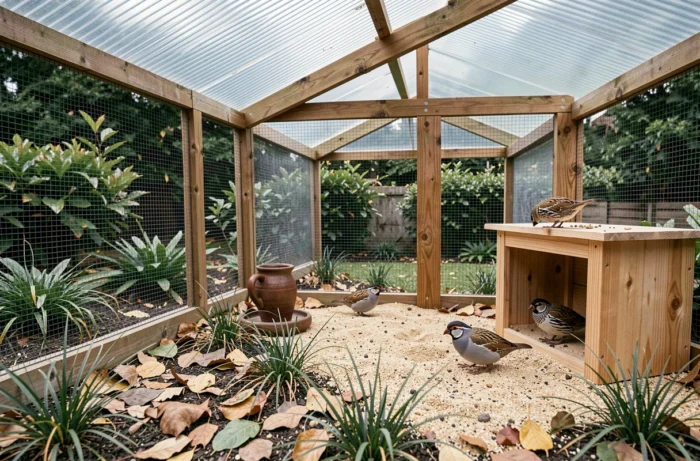
Fine sand mixed with sifted soil reproduces an environment close to their natural habitat. Non-resinous wood chips (poplar, beech) absorb moisture well but must be changed more frequently. Resinous wood chips (pine, cedar) should be avoided: the phenols they release irritate the respiratory tracts of these small birds.
Division into functional areas
Organizing the shelter into distinct zones improves comfort and reduces stress:
- A resting area, partially covered by a small roof or board, which gives the birds a sense of protection and encourages them to sleep sheltered
- A food and water area, easily accessible and away from the resting corner to limit bedding contamination
- A sand bath area, with clean fine sand, allowing the quails to maintain their plumage and regulate external parasites
Chinese quails often sleep in a hollow in the ground rather than in a closed nest box. Providing a shelter open on one side, placed directly on the ground, corresponds better to their natural behavior than a high or fully enclosed nest box.
Protection against predators and securing the mesh
The mesh constitutes the first line of defense. Chinese quails are so small that they can pass through wide mesh. A fine mesh, such as rabbit wire, prevents both escapes and the intrusion of small predators like rats or weasels.
The fixings deserve as much attention as the mesh itself. A well-chosen mesh but poorly fixed can deform under the pressure of a predator or come loose over time. Stapling the mesh onto solid wooden battens, folding the sharp edges outward, protects the birds from injury and strengthens the durability of the structure.
The ground of the outdoor enclosure must also be secured. Burying the mesh about twenty centimeters below the surface prevents burrowing predators from digging a passage. Without this precaution, a rat can access the enclosure in a few hours.
The smallest flaw in a shelter for Chinese quails will always be exploited, by a predator or by the birds themselves. Regularly checking the condition of the mesh, hinges, and junction points remains the most cost-effective maintenance gesture in terms of security.