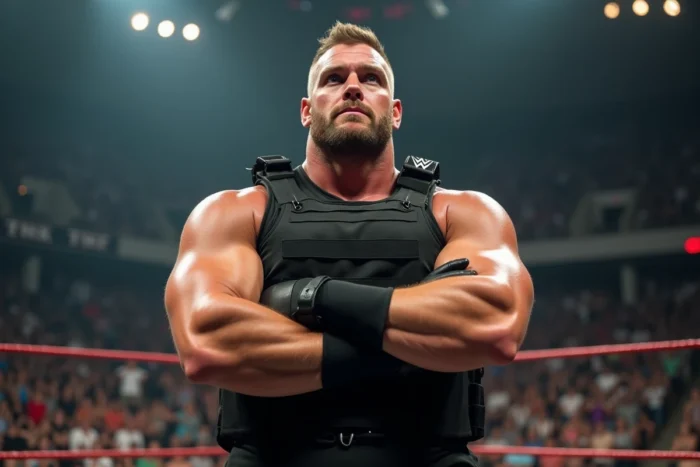
Roman Reigns is listed at 265 lbs, or about 120 kg at 6’3″. These measurements place him in a unique category within the WWE roster: too heavy to be considered a classic athletic wrestler, yet too light to fit into the super-heavyweight class. This intermediate position, rarely analyzed in detail, actually structures a large part of his longevity at the top of the card and the credibility of his matches.
Mobile powerhouse: a build that changes the fighting style
The historical super-heavyweights of WWE, like Big Show or Great Khali (announced at 450 lbs), imposed their dominance through sheer mass. Their matches relied on slow sequences, impactful strikes, and limited mobility. The format of modern main events no longer tolerates this pace. Pay-per-view main events regularly exceed half an hour and require quick sequences, twists, and solid cardio.
Roman Reigns occupies a niche that could be described as middle heavyweight. His 120 kg gives him the visual build of a dominant figure, one who projects his opponents with explosive Spears and Superman Punches. However, he retains the ability to keep pace with lighter and faster opponents like Seth Rollins.
It is this combination that makes his long main events credible. A wrestler weighing 150 kg would struggle to maintain intensity over 30 or 40 minutes without the audience losing interest. A wrestler weighing 95 kg would find it difficult to sell the image of the unbeatable champion that the Tribal Chief character demands. The detailed analysis of Roman Reigns’ weight highlights this alignment between build and narrative role.

Roman Reigns and The Shield: how weight distributed the roles
The Shield (Roman Reigns, Seth Rollins, Dean Ambrose) remains one of the most significant factions in WWE over the last decade. The physical dynamic of the trio partly explains the distribution of roles in matches.
- Seth Rollins, being lighter and more acrobatic, took on the role of the high-flyer capable of diving over the top rope and chaining aerial moves.
- Dean Ambrose embodied the unpredictable brawler, relying on endurance and the ability to absorb blows rather than brute strength.
- Roman Reigns, with his 120 kg, served as the finisher. He was the one delivering the final blow, the Spear, and absorbing attacks from the most imposing opponents during tag team matches.
This distribution was not incidental. It conditioned the way WWE later pushed Reigns as a solo performer. The finisher role within The Shield laid the groundwork for his positioning in the main event. His weight made the transition to an individual champion status credible, where a lighter wrestler would have required a different narrative arc to justify the same dominance.
The transition from NXT to the main roster
Before The Shield, Reigns worked in NXT under the name Leakee. His development period allowed him to adjust his physique to the demands of the main roster. The transition from college football to professional wrestling involved a transformation: less mass oriented towards the short impacts of football, more flexibility and endurance for matches lasting 15 to 45 minutes.
Roman Reigns himself has discussed the challenges of this transition between football and wrestling. The build of a football player and that of a wrestler do not respond to the same constraints. A football player needs explosiveness for a few seconds. A wrestler must maintain sustained effort for much longer while protecting their opponent at every hold.
Weight and longevity of the WWE Universal Championship reign
Roman Reigns’ reign as Universal Champion has exceeded 871 consecutive days (a figure reached in January 2023). Maintaining such a streak requires not only favorable booking but also the physical capacity to chain high-intensity matches without major injury.
Very heavy wrestlers experience more joint stress, particularly in the knees and back. Wrestlers who are too light for their division struggle to impose the physical dominance that the storyline demands. Reigns’ weight is in a zone that limits both of these risks.

His diet, described in several sources as focused on regular, high-quality protein intake, aims to maintain this muscle mass without excess body fat. The goal is not to weigh as much as possible but to stay within the range that maximizes power and endurance.
The contrast with WrestleMania opponents
At WrestleMania, Reigns faced very varied physical profiles. Against Brock Lesnar (announced at around 130 kg), the weight difference remained manageable, and both wrestlers could exchange credible power sequences. On April 3, 2022, Reigns defeated Lesnar to become the unified universal champion, a match where the size proximity between the two men allowed for a visually balanced fight.
Against lighter opponents like Daniel Bryan, the weight differential served the narrative: the smaller wrestler had to compensate with technique and speed, creating a narrative tension that the audience easily identifies.
Modern wrestling and the evolution of builds in the WWE roster
The WWE roster has significantly evolved over the past fifteen years. The era when only giants accessed the world title is over. The available data does not allow for a precise average weight of the current roster, but the general trend is towards more athletic and less massive wrestlers than during the Attitude or Ruthless Aggression eras.
In this context, Reigns’ 120 kg gives him an immediate visual advantage. He physically dominates the majority of his opponents without needing narrative artifices to justify his superiority. His physique tells the story even before the match begins.
The PWI 500 ranking, which placed him number one from July 2015 to June 2016, already reflected this combination of factors: a strong character, dominant booking, but also a physical profile suited to the headliner role. Roman Reigns’ weight is not just a number on a technical sheet. It is a performance parameter that conditions his style, his injury resistance, and the plausibility of his victories against any type of opponent.