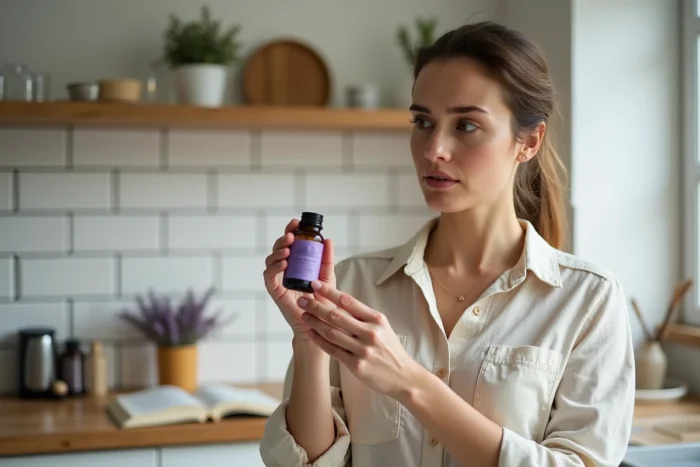
Linalool and linalyl acetate, two major monoterpenes of true lavender essential oil (Lavandula angustifolia), have attracted regulatory attention since Ramsey’s work published in 2019. Their estrogenic activity on the ER-alpha receptor, measured in vitro, has been enough to trigger a wave of alarmist articles. Here, we propose a technical reading of this issue, distinguishing laboratory data from real exposure conditions.
Endocrine activity in vitro: what the tests really measure
The monoterpenes implicated in lavender, linalool, linalyl acetate, 4-terpineol, and alpha-terpinene, exhibit measurable affinity for the ER-alpha receptor in cell assays. The work of Ramsey (2019) and Henley (2007) used MCF-7 cell lines exposed to these isolated compounds at concentrations far exceeding doses achievable through skin absorption or atmospheric diffusion.
This distinction is fundamental. An in vitro test exposes cells to a pure molecule, in direct solution, without a skin barrier, without hepatic metabolism, and without plasma dilution. The estrogenic activity detected in vitro does not predict an in vivo effect at commonly used concentrations.
The relationship between lavender essential oil and endocrine disruptors relies on this direct extrapolation from the test tube to the care bottle, without considering actual pharmacokinetics. We observe that most popular articles omit this step, which skews the risk assessment.
Prepubertal gynecomastia: the clinical case that sparked the lavender controversy
The initial alert dates back to 2007, with the publication of Henley et al. in the New England Journal of Medicine. Three cases of prepubertal gynecomastia were reported in boys using products containing lavender or tea tree. The withdrawal of the products led to a regression of symptoms.
Three cases do not constitute an epidemiological study. No control group, no quantification of exposure, no analysis of the exact composition of the products used. One of the implicated products was a cologne containing synthetic fragrances, not pure essential oil.
Controlled human studies are still lacking to this day. No randomized clinical trial has demonstrated an endocrine disrupting effect of lavender essential oil in humans, at any dose. The available data remain limited to isolated clinical observations and cell tests.
Dose-response and real exposure: the factor that precautions ignore
Toxicology is based on a simple principle: the dose makes the poison. For lavender monoterpenes, the question is not whether they can interact with a hormonal receptor (this is demonstrated in vitro), but whether the amounts absorbed during normal use reach the threshold for effect.
Several parameters drastically reduce actual exposure:
- The standard skin dilution in aromatherapy is between a few percent of essential oil in a carrier oil, which lowers the concentration of linalool to very low levels upon contact with the skin
- The skin barrier allows only a fraction of the applied monoterpenes to pass, varying according to skin integrity, application area, and contact duration
- Hepatic metabolism quickly degrades absorbed linalool, with a short plasma half-life that limits systemic accumulation
- Atmospheric diffusion exposes to even lower concentrations, on the order of traces in ambient air
The gap between the active dose in vitro and real exposure is measured in orders of magnitude. This data should structure the debate, not the mere presence of biological activity in the laboratory.
Sensitive populations: proportionate precautions
Infants, pregnant women, and prepubertal children exhibit increased hormonal sensitivity. We recommend avoiding the topical application of pure lavender essential oil in infants, not because the endocrine risk is proven, but because the immaturity of the skin barrier increases absorption and specific safety data is lacking.
In adults, moderate use in dilution poses no documented endocrine risk. Intermittent atmospheric diffusion remains the least concerning and lowest exposure route.

REACH regulation and classification of lavender essential oils
The European REACH regulation (Registration, Evaluation, Authorisation of Chemicals) governs substances based on their toxicological profile. Lavender is the subject of discussions at the European level, particularly regarding the CLP classification (Classification, Labelling, Packaging) of some of its components.
The regulatory issue revolves around the distinction between hormonal modulator and endocrine disruptor. A hormonal modulator interacts with the endocrine system without causing demonstrated adverse effects. An endocrine disruptor, according to the WHO definition adopted by European health authorities, must meet three simultaneous criteria: be a chemical substance, modify hormonal function, and produce a harmful effect on health.
To date, lavender essential oil has not been classified as an endocrine disruptor in the regulatory sense. Tests conducted under REACH have not provided evidence of a reproducible adverse effect in vivo. The French lavender sector has mobilized significant resources to produce the toxicological data required by this regulatory framework.
What the absence of classification means
The absence of classification does not mean total absence of risk. It means that current data do not meet regulatory criteria to justify a restriction of use. Monitoring continues, and new studies could alter this assessment.
The lavender issue illustrates a recurring problem in the toxicology of natural products: the confusion between identified danger in vitro and real risk under usage conditions. Natural molecules do not benefit from a free pass, but they also do not deserve condemnation based on unvalidated extrapolations. The proportionate approach remains to dilute properly, adapt routes of administration to populations, and follow the evolution of regulatory data without succumbing to alarmism or denial.