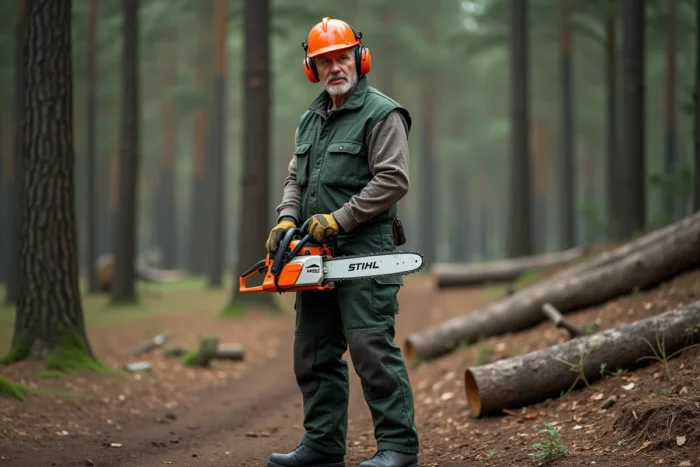
A Stihl gas chainsaw starts according to a precise mechanical sequence: chain brake, fuel priming, starter positioning, and then pulling the starter. Each action prepares the next one. Skipping a step or reversing the order results in, at best, a failed start, and at worst, a dangerous kickback.
Chain brake and decompression valve: what happens before the first pull of the starter
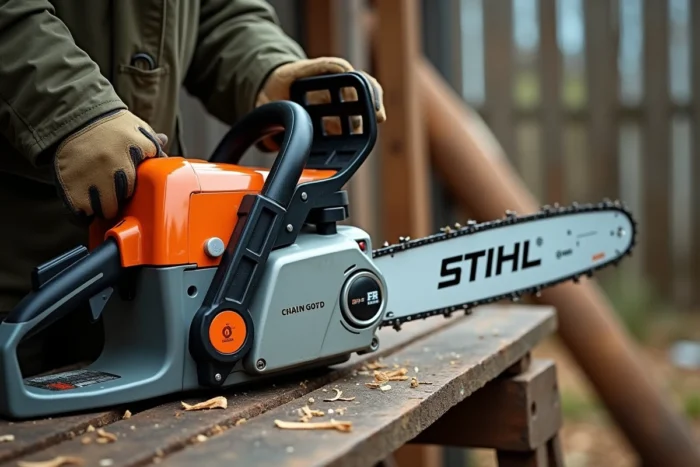
The chain brake must be engaged before any attempt to start. It is activated by pushing the front hand guard forward until it clicks. This locking mechanism prevents the chain from rotating if the engine revs uncontrollably at startup.
Next, remove the chain guard. Starting with the guard in place prevents proper ventilation of the guide and distorts the chain’s behavior in the first few seconds of operation.
On models equipped with a decompression valve, pressing it reduces the compression in the cylinder. This action requires a firm press, just once. The resistance when pulling the starter decreases significantly, which limits physical effort and sudden movements.
The priming pump (transparent bulb on the housing) should be pressed at least ten times. The fuel should become visible in the bulb. On a cold engine that hasn’t run for several days, insufficient priming forces multiple pulls on the starter, which tires the arm and wears out the recoil mechanism. Knowing how to start a Stihl chainsaw according to its exact model avoids these uncertainties.
Ground starting of a Stihl chainsaw: body position and pulling action
The starting must be done on the ground, never in the air. The chainsaw rests flat, the guide away from any obstacles. The right foot goes into the rear handle to press the machine against the ground.
The left hand firmly grips the front tubular handle. This grip prevents the chainsaw from tipping sideways during the pull.
Pulling sequence on a cold engine
- Place the combined control lever in the cold start position (starter closed, identified by a flap icon). This position enriches the air-fuel mixture to compensate for the low engine temperature.
- Pull the starter handle gently until you feel a distinct resistance (compression point), then give a firm and quick pull, arm extended. The wrist remains aligned with the forearm to avoid tendonitis.
- After one or two pulls, the engine coughs briefly. Then switch the lever to the hot start position (starter open) and pull again. The engine starts.
- Let it run for a few seconds at idle, then disengage the chain brake by pulling the hand guard towards you.
On a warm engine, skip the closed starter step. Enriching the mixture on a warm engine floods the spark plugs and complicates restarting.
ErgoStart and M-Tronic systems: what changes on recent models
The Stihl MS C-BE series and some compact models incorporate the ErgoStart system. An intermediate spring accumulates the pulling energy and gradually releases it to the crankshaft. The action becomes slower, smoother, and without jolts. The classic abrupt pull is counterproductive on these versions: it short-circuits the accumulation mechanism and delays starting.
The M-Tronic system electronically manages the carburetor adjustment. It detects whether the engine is cold or hot and automatically adjusts the mixture. The starter lever is eliminated on these models. The sequence is simplified: chain brake, decompression valve, priming pump, pull. No starter manipulation, no risk of flooding.
This difference between classic models and electronically managed models is the primary source of confusion. Applying the manual procedure on an M-Tronic (looking for a starter position that does not exist) wastes time. Check the exact model designation on the nameplate, near the housing, before the first start.
Personal protective equipment for starting a chainsaw
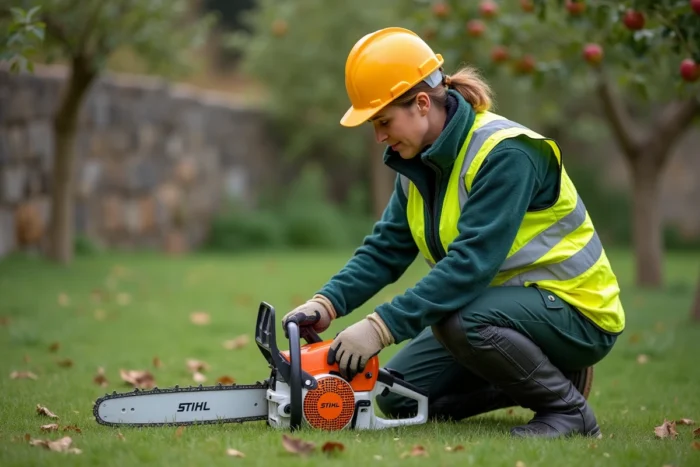
Professional trainers in green spaces emphasize wearing PPE from the starting phase, not just during cutting. A kickback can occur in the first few seconds of operation, even before the operator begins sawing.
- Helmet with mesh visor and integrated ear protection: protects from engine noise and debris from the moment of accelerated idle.
- Cut-resistant gloves: the left hand on the front handle is the most exposed in case of chain breakage or kickback at startup.
- Cut-resistant pants (protection class suitable for the intended work): even on the ground, the chain can come into contact with the legs if the machine slips.
- Safety shoes with a treaded sole: the foot in the rear handle must hold firmly, especially on wet or sloped terrain.
Wear PPE before touching the chainsaw, not after starting. Once the engine is running, removing hands from the machine to put on gloves exposes you to unnecessary risk.
Pre-start maintenance: checks to avoid running out of fuel
Before each session, check the level of the fuel tank and the chain oil reservoir. A Stihl gas chainsaw consumes both liquids simultaneously. The oil reservoir empties slightly faster than the fuel tank on most models.
Check the chain tension: it should be able to be pulled a few millimeters under the guide and then return to place. A chain that is too loose will derail at the first contact with wood. A chain that is too tight will overheat and wear out prematurely.
Also check the condition of the air filter. A clogged filter weakens the mixture, complicates cold starting, and increases consumption. A quick cleaning with compressed air or a brush before each use extends the engine’s lifespan and makes starting more reliable.
The guide bar deserves a visual inspection: clean groove, absence of burrs on the rails. A deformed guide causes a skewed cut and puts abnormal stress on the engine from the first seconds of work.