
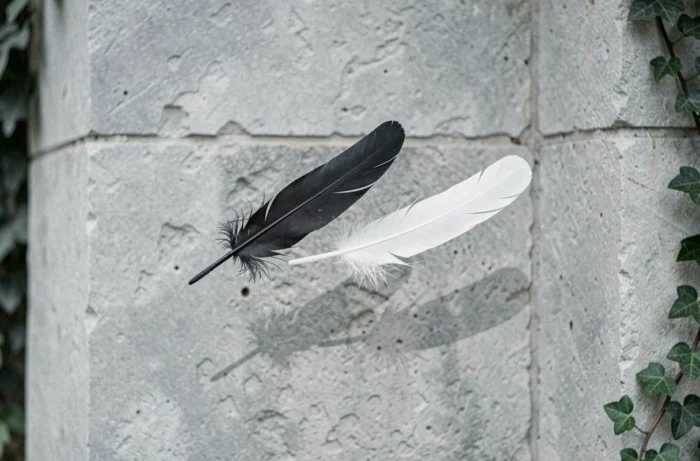
A black and white striped feather attracts the eye more than a solid-colored feather. The visual contrast is striking, and the symbolic charge that accompanies it is equally pronounced. The black and white feather concentrates two polarities in a single object: light and shadow, the end and the beginning. Understanding what this symbol conveys on a spiritual level requires untangling what each color carries separately, and then observing what happens when they merge.
Duality of black and white on the same feather: what color tells
White, in most spiritual traditions, refers to purity, peace, and a form of protective presence. It is often associated with a message of comfort or guidance.
Black carries a different energy. It evokes protection, transformation, and wisdom gained through trial. Far from being negative, black symbolizes what matures in the shadows before revealing itself.
When both colors coexist on the same feather, the message changes in nature. It is no longer a simple signal (peace or transformation) but a sign of balance between two complementary forces. The bicolored feather conveys the idea that light does not exist without shadow, and that both participate in the same movement. Exploring the spiritual meaning of a black and white feather involves accepting this productive tension between opposites.

Black and white feather: interpretations depending on the context of discovery
Have you ever noticed that a feather found on the ground does not have the same effect depending on when it appears? The context alters the reading of the sign.
In times of doubt or transition
Finding a black and white feather during a phase of questioning is often interpreted as a sign of reassurance in the face of a difficult choice. The two colors suggest that the decision to be made is neither entirely good nor entirely bad. It contains elements of shadow and clarity that must be accepted together.
In times of mourning or loss
In this context, the bicolored feather is often perceived as a message of presence. Black represents passage, separation. White carries continuity, regained peace. Together, they form a symbol of transition between two states of existence.
Without a specific context
When the feather appears for no obvious reason, it is read as an invitation to observe the contrasts in one’s own life. What imbalances require attention? Where is the boundary between what we show and what we keep to ourselves?
Birds bearing black and white feathers: animal symbolism
The species of bird from which the feather comes guides the spiritual reading. This is not a trivial detail.
- The magpie has a very contrasting black and white plumage. In several European folklores, it is associated with duality, curiosity, and communication between visible and invisible worlds.
- The pied crow (or collar crow) combines the energy of the crow, linked to wisdom and transformation, with the clarity of white. Its feather is often read as a sign of enhanced protection.
- Some species of birds of prey have feathers striped with black and white. They evoke keen vision, the ability to distinguish truth from falsehood.
Identifying the bird is not always possible. When it is, the animal symbolism enriches the reading. When it is not, the combination of colors is sufficient to carry the message.
Found feather and cultural appropriation: a limit to know
Picking up a feather along the way seems innocuous. However, the legal and cultural dimension of this gesture is real.
In many Indigenous nations of North America, feathers are not mere objects but earned, gifted, and sanctified elements. An eagle feather, for example, is earned through acts recognized by the community. Treating it as a decorative object or personal talisman directly conflicts with these traditions.
Legally, in the United States, the possession of eagle feathers is regulated by the Bald and Golden Eagle Protection Act and the Migratory Bird Treaty Act. Non-members of federally recognized tribes cannot possess, sell, or transport these feathers without permission.
This reality invites a distinction between two approaches. The first: welcoming the sign of a randomly found bicolored feather, respecting one’s own spiritual sensitivity. The second: appropriating rituals or objects from cultures to which one does not belong. The boundary between personal inspiration and cultural appropriation deserves to be clearly established.
Integrating the message of a black and white feather into daily life
Receiving a sign produces nothing if it is forgotten within hours. Here are three concrete ways to extend the effect of this discovery:
- Note in a journal the date, location, and emotional context of the discovery. In hindsight, patterns may sometimes emerge.
- Place the feather in a visible spot (desk, bedside table) as a physical reminder of the balance to be maintained between energy and rest, action and introspection.
- Observe in the following days if a theme of duality recurs in dreams, conversations, or decisions to be made. The feather often acts as a marker of the beginning of a cycle.
The meaning of a black and white feather is not reduced to a fixed reading grid. It depends on the person who finds it, the moment, and the attention given to the sign. What remains constant is the central message: harmony arises from the acceptance of opposites, not from their suppression.