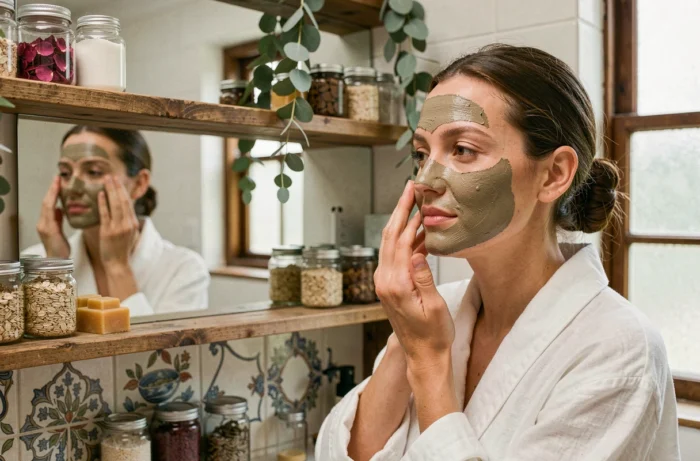
A bulk purchase of a nourishing soap that tightens after the third day, a vegetable oil that makes the T-zone shine within an hour: we’ve all experienced that moment when the promised natural beauty routine doesn’t suit our skin. The problem rarely lies with the ingredients themselves, but rather with how we combine them and when we apply them. Building an effective daily natural beauty routine requires fewer products than one might think, provided we understand a few concrete mechanisms.
Analyze cosmetic labels before the regulation of September 2026
The Directive (EU) 2024/825, applicable from September 27, 2026, will prohibit vague environmental claims on consumer products, including cosmetics. Terms like “natural,” “green,” or “eco-friendly” must be backed by independent evidence or rely on a recognized label. Self-proclaimed labels created by brands without third-party certification will be banned.
In practical terms, when choosing a face care product or cream, checking for a certified label (Cosmos, Natrue, Ecocert) offers better protection than a homemade logo. A product that claims to be “formulated with organic ingredients” when only one component is organic may be considered misleading. For those looking to compare formulations and find reliable products, you can discover the Belle et Naturelle website, which lists already certified ranges.
On the ground, reading the INCI list remains the most reliable reflex. The first five ingredients represent the essence of the formula. If “aqua” and a silicone derivative top the list, and the vegetable oil highlighted on the packaging appears at the end, the natural promise does not hold.

Facial cleansing: choose the texture according to your skin
Cleansing is the step where most mistakes occur. A cold saponified soap is suitable for normal to combination skin, but on dry or reactive skin, it can destabilize the hydrolipidic film within a few days. In this case, a milk or oil cleanser rinsed with lukewarm water cleanses without stripping.
Combination to oily skin: the trap of aggressive cleansing
It is believed that oily skin needs a powerful cleanser. The opposite is true: overly stripping cleansing stimulates sebum production. A gentle sulfate-free gel, used morning and night, regulates shine better than an astringent soap. Green clay, often recommended, works as a weekly mask, not as a daily cleanser.
Sensitive skin: rely on hydrosols
A chamomile or cornflower hydrosol applied with cotton is a great substitute for tap water for rinsing. Hard water exacerbates tightness on reactive skin. Feedback on this point varies by region, but in very hard water areas, this simple change often makes a difference in a few weeks.
Natural hydration: adapt care to the time of day
Hydrating in the morning and nourishing in the evening is the basic principle. In practice, the distinction relies on the textures and active ingredients chosen.
- In the morning, prioritize a light aloe vera-based care or a watery serum that absorbs quickly without leaving a greasy film, compatible with a sunscreen applied on top.
- In the evening, a vegetable oil suited to your skin type (jojoba for combination skin, sweet almond for dry skin, black cumin for blemished skin) nourishes and supports nighttime regeneration.
- In winter or in a heated environment, adding a rich cream over the evening oil compensates for the increased transepidermal water loss caused by heating.
Applying oil on slightly damp skin improves absorption and avoids the “greasy that doesn’t absorb” effect. It’s a simple gesture that changes the result.

Multifunctional products for a minimalist beauty routine
Multiplying natural products does not make the routine more effective. On the contrary, a well-chosen product can cover several needs and simplify daily life without sacrificing skin radiance.
Honey, for example, works as a gentle cleanser (applied pure on damp skin and then rinsed), a hydrating mask, and a light healing agent for minor imperfections. A jar of raw honey replaces three distinct products in a minimalist bathroom.
Jojoba oil also deserves its place: it regulates sebum, removes makeup, hydrates hair lengths, and softens cuticles. It is used in the evening as a face treatment, in the morning as a touch on the ends, without changing bottles.
Three criteria to evaluate a multifunctional product
- The INCI list does not exceed ten ingredients, which limits the risk of cross-irritation.
- The product works on at least two areas (face, body, hair) without excessively adjusting the quantity.
- Its texture remains stable over time, without phase separation or odor that turns after a few weeks.
Reducing the number of products also allows for better observation of skin reactions. When using six products, identifying which one causes redness or a pimple becomes a puzzle. With three well-targeted actions (cleansing, hydration, protection), each visible change can be linked to a specific product.
Adopting a natural beauty routine is not about the quantity of products or marketing promises. A certified cream, a cleanser suited to your skin, and a well-chosen vegetable oil cover most daily needs. The rest is about consistency and a bit of patience to let the skin adapt.