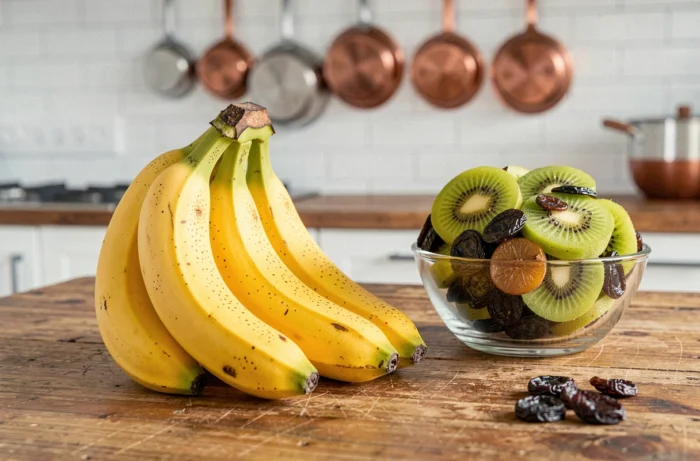
The banana is often mentioned in both camps: a natural laxative for some, a factor of constipation for others. The answer largely depends on the ripeness stage of the fruit and, more recently, on the microbiotic profile of the person consuming it.
Resistant starch from green banana and colonic fermentation
The unripe banana contains a high proportion of type 2 resistant starch, a carbohydrate that escapes digestion in the small intestine and reaches the colon intact. This substrate undergoes bacterial fermentation there, producing short-chain fatty acids, notably butyrate, known to stimulate colonic motility and hydrate stools.
As the banana ripens, this resistant starch converts into simple sugars. A well-yellow banana with brown spots contains almost none. The benefit for transit is therefore concentrated on the green or barely yellow banana, not on the fruit that most consumers buy.
This mechanism explains why clinical trials in pediatrics use green banana (in powder or puree form) as a complementary strategy against functional constipation in children. The results show a measurable improvement in stool consistency compared to standard management alone.
The ripeness stage is a parameter in its own right when advising on this fruit. To delve deeper into the link between banana and laxative effect, you can read the article on Le Manifeste Sante that details these mechanisms.
Variable response according to intestinal microbiota

A study published in 2025 in npj Biofilms and Microbiomes followed 61 healthy adults consuming a resistant starch-rich unripe banana powder three times a week for six weeks. The findings challenge the idea of a universal effect of banana on transit.
Only subjects with a Prevotella-dominant profile showed a significant change in microbiota and associated metabolic functions. Participants whose microbiota was dominated by Bacteroides showed little to no response to supplementation.
This data has direct implications. Prescribing green banana as support for transit without considering the microbiotic terrain ignores a major variable. Here we see a typical case of nutrient-dependent microbiota response, a phenomenon increasingly documented in the prebiotic literature.
Consequences for clinical practice
- A patient suffering from functional constipation with a Prevotella-dominant profile could benefit from supplementation with resistant starch from green banana, integrated into a comprehensive strategy including soluble fibers and hydration.
- In a Bacteroides-dominant profile, the expected effect on transit will likely be weak. Other sources of fermentable fibers (kiwi, legumes, psyllium) should be prioritized.
- In the absence of microbiota typing, recommending green banana remains relevant as a first-line approach, but without a guarantee of individual results.
Ripe banana and constipation: a real effect or a nutritional myth
The well-ripened banana provides soluble fibers, notably pectins, which contribute to the regulation of transit. Their content remains modest compared to other fruits like apple or kiwi. The ripe banana does not cause constipation in the pharmacological sense: it does not inhibit intestinal motility or water secretion in the colon.
The misconception likely arises from the dense texture of the fruit and its historical use in the BRAT diet (bananas, rice, applesauce, toast), prescribed in cases of diarrhea. In this context, the ripe banana slows down an accelerated transit, which is not the same as causing constipation in a normal transit.
For a person whose transit is already slow, the ripe banana will not notably worsen the situation, but it will also not provide the boost that the green version does. The choice of ripeness stage determines the effect on transit, and this distinction is rarely made in public nutritional advice.
Comparison of banana and other fruits against constipation
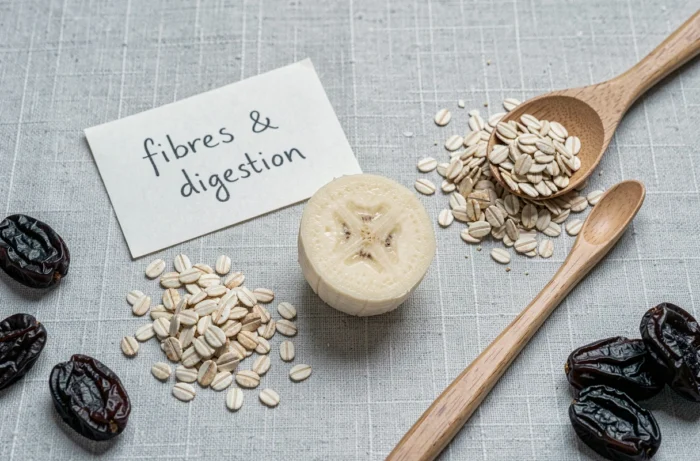
Positioning the banana within the landscape of fruits used to improve transit allows for a nuanced understanding of its relative interest.
| Fruit | Dominant fiber type | Mechanism on transit | Level of evidence |
|---|---|---|---|
| Green banana | Resistant starch | Colonic fermentation, butyrate production | Pediatric clinical trials |
| Kiwi | Soluble and insoluble fibers, actinidin | Stool hydration, enzymatic stimulation | Several controlled trials in adults |
| Apple (with skin) | Pectins, cellulose | Hydrating gel, increased fecal volume | Observational data |
| Ripe banana | Pectins (modest amount) | Mild regulation, neutral to slightly positive effect | Low |
Today, kiwi has a stronger body of evidence than banana for functional constipation in adults. The green banana remains an interesting option, particularly in pediatrics, but it is not the most effective fruit against constipation in adults.
The combination of multiple sources of fiber (vegetables, legumes, varied fruits) with adequate water intake remains the foundation of any dietary strategy against constipation. The banana, preferably green, finds its place as a complement, not as a sole solution. The ripeness stage and the microbiotic terrain of the patient are the two variables that determine whether this fruit will have a concrete effect on stools.