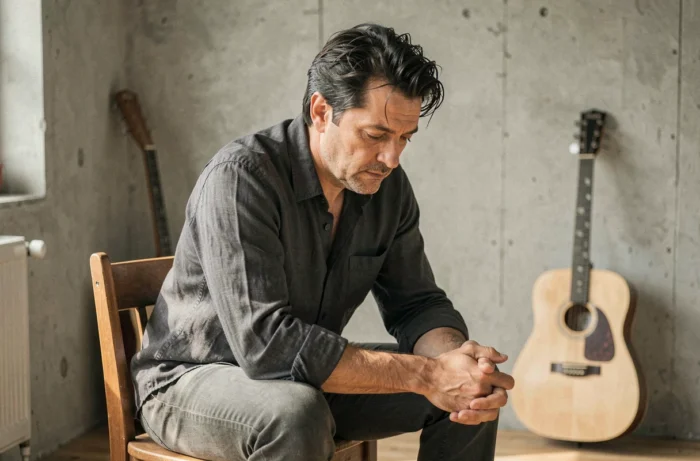
Gaëtan Roussel has never publicly named his condition with the precision that the press attributes to him. For several years, the singer from Louise Attaque has been the subject of articles claiming that he has battled cancer, while his own statements lean more towards an autoimmune disease. This confusion, fueled by catchy headlines, deserves to be examined before discussing struggle or rebirth.
Autoimmune disease or cancer: what Gaëtan Roussel has really stated
The majority of articles dedicated to the singer’s health use the word “cancer” right in the title. Analyses published in 2026 by medical fact-checking sites highlight a discrepancy between these headlines and the artist’s own statements. In his lengthy interviews, Gaëtan Roussel would rather refer to an autoimmune disease, without ever explicitly confirming a cancer diagnosis.
This semantic shift is not trivial. Attributing cancer to a public figure without a clear primary source is an editorial shortcut, even sensationalism. The sites Hop-Santé and La Meilleure Mutuelle, which have analyzed Gaëtan Roussel’s illness in detail, describe any clinical precision (type of pathology, stage, protocol) circulating online without being directly attributable to the singer as speculative.
No reliable and public medical details exist to date regarding the treatment followed. This lack of verifiable data should encourage caution, including for the media covering the topic.
The loss of his father during Gaëtan Roussel’s illness
Alongside the physical difficulty, a family tragedy has emerged. Gaëtan Roussel has confided in several interviews that his father passed away the same year as his illness episode. “My dad was young,” he stated, sharing a rare insight for an artist who is usually discreet about his private life.
The simultaneity of grief and illness sheds a different light on the period of silence that preceded his return. The singer did not simply experience a professional halt for health reasons. He faced two trials in parallel, without ever instrumentalizing this narrative for promotional purposes.
This restraint contrasts with the media treatment that typically surrounds celebrities’ confessions about illness. While other artists build a public narrative around their recovery, Roussel shares snippets, spaced out over time, without dramatization.
Album Marjolaine and return to the stage: a measured musical rebirth
The word “rebirth” is consistently associated with articles about Gaëtan Roussel’s return. The reality is more nuanced. The album Marjolaine, released after this difficult period, has not been presented by its author as a testimony album about illness. The songs do not directly recount a medical struggle.
Several clues suggest that writing played a role in his reconstruction, but Roussel rejects the heroic narrative of healing through art. In interviews, he talks about music, lyrics, collaboration with other musicians, rarely about his health. The link between illness and creation remains implicit, left to the listener’s interpretation.
Louise Attaque and solo career: two distinct timelines
The return to activity has taken place on two fronts. Louise Attaque, the band formed in the 1990s, continues to tour. In parallel, Gaëtan Roussel pursues a solo career with his own concert dates and albums.
This dual activity complicates the public’s understanding of his journey. Online searches frequently mix the two projects, and the question of illness is associated with both the band and the solo artist. In reality, Louise Attaque functions as a collective space where the personal dimension of the singer fades behind the shared repertoire.
The announced tour dates for late 2026, notably in Le Havre and at several festivals in France, confirm a sustained activity pace. Gaëtan Roussel does not project the image of a convalescent artist, but rather of a musician in full activity who has chosen not to make his health a central topic.

Public discourse on illness: the limits of what can be asserted
The media coverage of Gaëtan Roussel’s health illustrates a broader phenomenon. When an artist shares a confidence during an interview, that phrase is picked up, rephrased, amplified by dozens of sites until it becomes a “fact” that no one verifies anymore. The cancer diagnosis, repeated from article to article, eventually imposes itself as certainty even though the primary source does not explicitly confirm it.
The available data does not allow for a conclusion about the exact nature of the condition. This observation does not diminish the reality of the ordeal faced by the singer. It simply raises a question about the editorial responsibility of the media covering the health of public figures.
Several points deserve to be noted regarding this matter:
- Gaëtan Roussel has never formally used the word “cancer” in an identifiable primary source, his statements leaning more towards an autoimmune disease.
- The death of his father, which occurred the same year as his illness, added a dimension of grief rarely mentioned in quick summaries.
- The album Marjolaine and the resumption of concerts are not presented by the artist as a narrative of healing, but as the logical continuation of his musical work.
The singer from Louise Attaque continues to perform on stage in France with a regularity that speaks for itself. His discretion on the medical topic remains constant, and nothing indicates that he wishes to make it a communication element. The silence chosen by Roussel may be the clearest response to those seeking details he has not wished to provide.