
You open your mouth in front of the mirror one morning and notice wavy marks on the edges of your tongue, as if the teeth have left their imprint in the flesh. This serrated relief has a name: scalloped tongue. Far from being a mere aesthetic detail, these lateral dental imprints often signal a slight swelling of the tongue or repeated mechanical pressure against the dental arch.
Mechanical pressure and lingual edema: the concrete mechanism of the scalloped tongue
The scalloped tongue is not a disease in itself. It results from prolonged contact between the tongue and the teeth, which eventually shapes the edges. Two situations provoke this phenomenon.
The first is a slightly enlarged tongue. A subtle edema is enough for the tongue to occupy more space in the oral cavity and press continuously against the teeth. The imprints then appear even at rest.
The second concerns habits of active pressure. Bruxism (clenching or grinding of teeth), chronic mouth breathing, and simply pressing the tongue against the palate or teeth during the day accentuate the marks. There is often a component of stress or muscle tension in these cases. To better understand the causes and treatments of the scalloped tongue, it is beneficial to distinguish these two mechanisms, as the management differs depending on the origin.

Hypothyroidism and fluid retention: when the scalloped tongue points to a general problem
A lingual edema does not come out of nowhere. Among the most documented systemic causes, fluid retention related to a hormonal imbalance holds a notable place. The thyroid, in particular, deserves attention.
Early-stage hypothyroidism can cause diffuse swelling of soft tissues, including the tongue. If the dental imprints are accompanied by persistent fatigue, unexplained weight gain, or dry skin, these combined signs warrant a thyroid evaluation. The scalloped tongue alone is not enough to make a diagnosis, but it can be the first visible clue that prompts a consultation.
Water retention without thyroid pathology
A diet very high in sodium, certain medications, or hormonal fluctuations (menstrual cycle, pregnancy) can also lead to mild retention. In these situations, the dental marks are often more pronounced in the morning upon waking and diminish throughout the day as fluids redistribute.
Sleep apnea and mouth breathing: an underestimated link with dental marks
People rarely think about sleep when observing their tongue. Yet, obstructive sleep apnea is among the most significant medical causes of scalloped tongue.
During apnea episodes, the tongue retracts and partially blocks the airways. The body compensates by pushing the tongue forward against the teeth. This repeated pressure, night after night, carves the characteristic lateral imprints.
Feedback varies on this point, but several practitioners observe that the disappearance of dental marks often accompanies improved sleep after the implementation of appropriate treatment (mandibular advancement device or continuous positive airway pressure ventilation). The scalloped tongue can therefore serve as a simple visual indicator to guide screening for apnea, especially if it is accompanied by snoring, daytime sleepiness, or waking with a dry mouth.
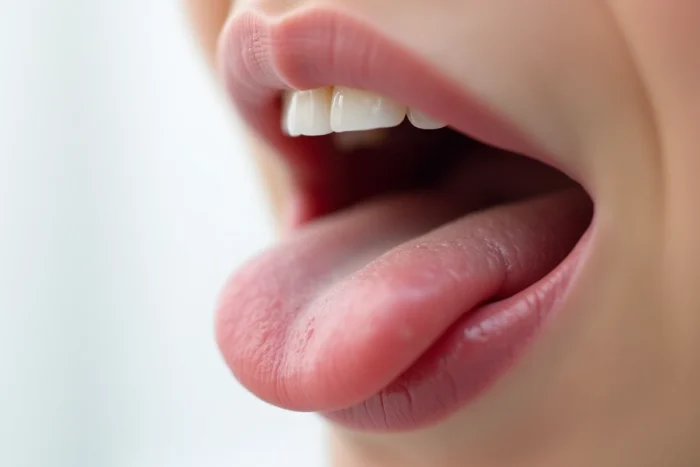
Symptoms associated with the scalloped tongue and warning signals
The ripples on the edges of the tongue are rarely painful in themselves. It is the accompanying symptoms that guide the diagnosis. Here are the signs to watch for:
- A sensation of dry mouth upon waking, suggesting nocturnal mouth breathing or a salivary flow issue
- Jaw pain or morning headaches, often related to bruxism
- A visible swelling of the tongue that hinders speech or chewing
- Chronic fatigue associated with sleep disturbances, which may point to apnea or a thyroid imbalance
An isolated scalloped tongue, without other symptoms, does not require urgent treatment. However, dental marks combined with persistent fatigue or snoring warrant a medical consultation to rule out an underlying cause.
Concrete solutions to reduce dental imprints on the tongue
Management directly depends on the identified cause. Addressing the symptom alone leads nowhere if the mechanism persists.
Bruxism and muscle tension
Wearing an occlusal splint at night reduces the pressure exerted on the tongue. Jaw relaxation exercises (gently opening and closing, massaging the masseter muscles) help relieve the tension accumulated during the day.
Mouth breathing and sleep apnea
Lingual rehabilitation, sometimes supervised by a speech therapist, aims to reposition the tongue against the palate rather than against the teeth. For confirmed apnea, specific treatment (splint or ventilation) addresses the root of the problem.
Fluid retention and hypothyroidism
A blood test can check thyroid function. If hormone replacement therapy is prescribed, the reduction of lingual edema generally follows thyroid balancing. On the dietary side, limiting sodium and maintaining good hydration help reduce retention.
Some oral hygiene practices complement the approach:
- Daily cleaning of the tongue with a tongue scraper to stimulate local circulation
- Avoiding very acidic or spicy foods that irritate the already marked edges
- Consulting a dentist to check dental alignment, as malocclusion can worsen the imprints
The scalloped tongue remains a signal that the body sends, not a fatality. By identifying the mechanism at play, whether it be nocturnal clenching, subtle edema, or a sleep disorder, one can address the cause and see the marks gradually fade.