
The meals that pile up, the homework to supervise, the activities to coordinate: family life often resembles a succession of tasks. Yet, a few concrete adjustments can change the quality of shared moments without requiring more time or energy. Enriching family life on a daily basis relies less on major upheavals and more on targeted, repeated habits tailored to each household.
Cost of parenting and family choices: a context that weighs on daily life
Before discussing tips, one observation must be made. According to an article from Parents published in August 2026, 80% of households believe that having a child has become a luxury. In the same survey, 76% of couples hesitate to expand their family due to the cost of parenting.
This economic climate directly influences daily decisions: choices of activities, trade-offs on vacations, whether or not to seek external help for childcare. Ignoring this parameter means offering advice disconnected from the reality of most families.
The joint report from the General Inspectorate of Finance and the General Inspectorate of Social Affairs, made public in the summer of 2026, reminds us that family policies represented 122.1 billion euros in 2024, with an average increase of 4.5% per year since 2021. Potential savings of 4.2 billion euros are being studied. For parents, this means that certain aids may evolve in the short term, and it’s better to stay informed. Numerous concrete resources can be found on the family section of C Nouveau to follow these topics and adapt family choices.
Create short rituals rather than long events
Have you ever noticed that the most memorable family memories are rarely linked to entire days of activity? A ten-minute ritual, repeated every day or every week, anchors a sense of stability much stronger than an exceptional outing organized once a quarter.
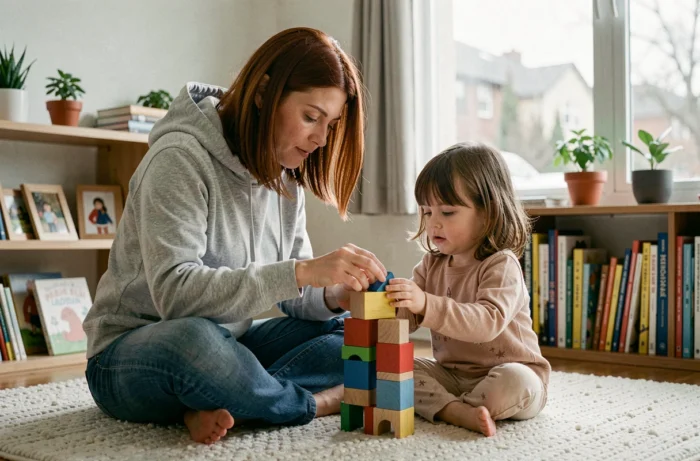
An effective family ritual lasts less than fifteen minutes and costs nothing. The goal is not to create a perfect moment, but a predictable reference point. When each family member knows that a moment is dedicated to them, daily tension decreases.
Here are a few examples that work without preparation:
- The dinner table round, where everyone shares a pleasant moment from their day (not an obligation, just an invitation).
- A shared reading time before bed, even five minutes, tailored to each child’s age.
- A fixed walk on Sunday mornings, always the same route, which becomes a space for informal conversation.
The common point: regularity matters more than duration. A four-year-old does not remember the trip to the amusement park. They remember the moment when their parent sits next to them every evening.
Children’s and parents’ emotions: naming to defuse
Managing emotions is the topic that generates the most friction in a household. A child throwing a tantrum in the supermarket, a teenager slamming the door, a parent losing patience after a day of work: these scenes are commonplace, but they erode the quality of family life if they remain unaddressed.
The simplest and most documented technique is to name the emotion out loud before seeking a solution. Saying “you are angry because your brother took your toy” does not immediately resolve the conflict, but it allows the child to feel understood.
This mechanism also works between adults. When one parent tells the other “I am tired and I feel like I am going to get angry,” they set a framework that prevents escalation. Parenting does not require never feeling frustration. It requires identifying what is happening to prevent daily life from becoming a series of unresolved conflicts.

Why choose verbalization over another tool? Because it requires no materials, no specific training, and can be practiced by children as young as three. A child who can name their emotions manages social relationships at school better.
Task distribution within the household: moving out of ambiguity
Mental load remains a major source of tension in families. The problem is not always the volume of tasks, but their invisibility. Remembering to buy toothpaste, checking the health booklet, anticipating a friend’s birthday gift: these micro-tasks accumulate and weigh on the person carrying them, often without the rest of the household being aware.
The first concrete step: make the invisible visible by listing all tasks on a shared platform. A whiteboard on the fridge, a family management app, a simple notebook: the format matters little. What counts is that each household member sees the entirety of what is done.
Next, the distribution should not be negotiated just once. Needs change with the seasons, schedules, and the age of the children. A monthly review of fifteen minutes is enough to adjust responsibilities without the topic becoming a recurring conflict.
- List daily, weekly, and monthly tasks on a platform accessible to all.
- Assign each task to a specific person, including children from the age of six or seven (tidying up their things, setting the table).
- Plan a quick monthly check-in to adjust the distribution according to changes in pace.
Involving children in household tasks is not exploitation. It gives them an active role in family life, which strengthens their sense of belonging and autonomy.
Enriching family life does not come from a rigid program or a list of good resolutions. The decline in birth rates in France, with around 645,000 births in 2025 according to INED, shows that the family project is becoming increasingly thoughtful. Families that function well are not those that do everything perfectly: they are those that adjust, communicate, and accept that some weeks are more challenging than others.