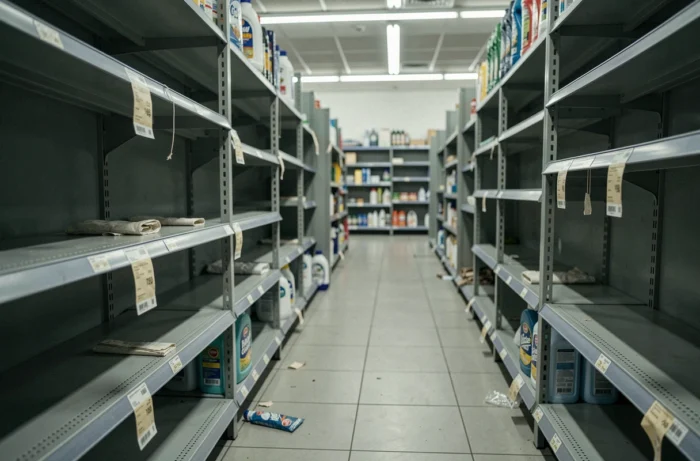
Looking for Domestos in the aisle, we come across an empty spot with a price tag still in place. The product is listed on the retailer’s website, sometimes even advertised on promotion. This gap between the digital showcase and reality in-store perfectly summarizes the Domestos shortage as it has manifested over the past few months.
Online stock versus empty shelves: what the discrepancy reveals about distribution
When checking the websites of major retailers, the Domestos product page often appears as available. You can even add it to your cart. The problem arises at the time of in-store pickup or delivery: the wait time increases, the slot disappears, or the product is simply substituted with another reference.
This phenomenon can be explained by how distributors manage their stocks. An active product page does not guarantee physical stock in a local warehouse. E-commerce platforms operate with centralized databases that aggregate inventories from multiple warehouses. A product may exist in a regional warehouse without being shipped to the nearest point of sale.
Some distributors also keep product pages active for commercial referencing reasons. Removing a listing means losing its sales history, customer reviews, and its position in internal search results. It becomes clearer why Domestos is no longer found on the shelves while everything seems normal online.
The promotions displayed on out-of-stock products pose an additional problem. They are sometimes scheduled weeks in advance through agreements between the manufacturer and the distributor. If restocking does not follow, the promotion becomes meaningless, which amplifies consumer frustration.
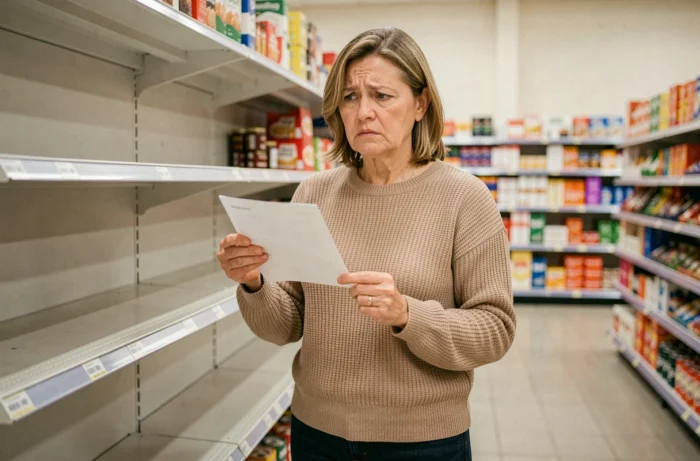
Domestos and supply chain: where the blockage lies
The production of Domestos relies on raw materials sensitive to market fluctuations, particularly chlorine and its derivatives. However, the production capacities of these chemical components depend on geographically concentrated facilities, creating points of vulnerability.
The bottleneck often occurs upstream of the factory, not downstream. Competitors on this issue mainly point to rising production costs. This is true, but incomplete. The real leverage point is the physical availability of inputs at the time when production lines need to run.
When a raw material supplier reduces its volumes (factory maintenance, prioritizing a more profitable client, regulatory constraints), the manufacturer is left with two options:
- Slow down production and deliver fewer references to distributors, prioritizing the best-selling formats
- Postpone the production of certain formats (specific toilet gels, large packaging) to concentrate resources on the flagship product
- Negotiate substitute raw materials, which may require new regulatory validation and delay market launch by several weeks
This type of reconfiguration is not visible to the consumer. We simply notice that the classic Domestos reappears intermittently, while some formats remain unavailable for months.
Domestos stockouts: why some retailers are more affected
Not all retailers experience the shortage in the same way. Returns vary on this point, but a recurring pattern is observed: stores with high turnover of hygiene products are restocked as a priority.
A hypermarket that orders entire pallets receives different treatment than a convenience store that places unit orders. Buying groups negotiate volumes, and when supply contracts, smaller volumes are the first to be sacrificed.
The role of private label brands in shelf management
When a national brand product is missing, the retailer does not leave the shelf empty. It repositions its own bleach-based cleaning brands or its eco-friendly alternatives. This replacement is not neutral: it alters the visibility of the absent product and can perpetuate its eviction from the shelf, even after normal supply returns.
A product that is absent for too long loses its place on the shelf. Planograms (product placement plans in-store) are revised periodically. If Domestos is not deliverable at the time of the revision, the space is reallocated. Returning to the shelf then requires a new commercial negotiation between Unilever and the distributor.
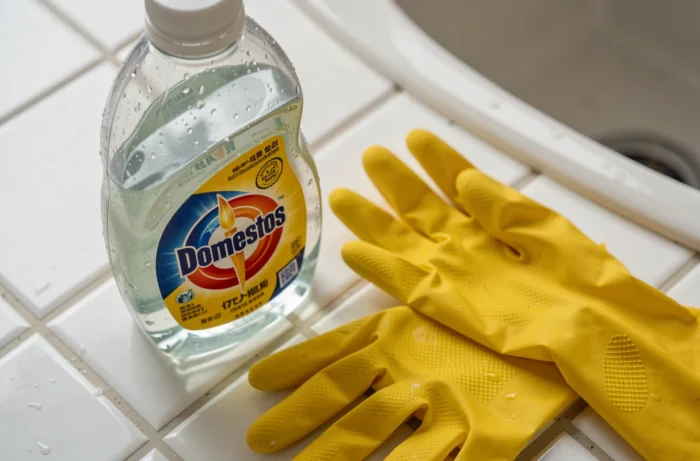
Alternatives to Domestos: what works as a replacement
In the face of repeated shortages, we end up testing other products. The market for disinfectant cleaners is not lacking in references, but not all are equal in terms of concentration of active agents.
- Concentrated bleach remains the most direct substitute: same active ingredient (sodium hypochlorite), lower price, widely available
- Toilet cleaners from competing brands (Harpic, Canard) offer comparable gel formulations for sanitary use
- Products based on citric acid or white vinegar are suitable for descaling but do not replace the disinfecting action of chlorine
The choice depends on the use. For strict disinfection (elimination of microorganisms), only products containing a declared biocide offer effectiveness comparable to Domestos. Eco-friendly cleaners clean, but most do not disinfect in the regulatory sense of the term.
Domestos shortage and prices: the mechanism of increase
When supply decreases and demand remains stable, prices rise. This is evident on marketplaces where Domestos is resold by third-party sellers at prices above the recommended retail price. This opportunistic resale phenomenon regularly affects out-of-stock products.
The rise in production costs also impacts shelf prices. Unilever, like other companies in the sector, adjusts its prices to absorb the increase in logistical and raw material costs. Consumers pay more for a product that is harder to find, which accelerates the shift to less expensive alternatives.
This dynamic creates a cycle: lower volume sold on the shelf reduces the retailer’s interest in maintaining the reference, which further decreases the product’s visibility. The Domestos shortage is not just a manufacturing problem. It is also a matter of commercial positioning in a rapidly evolving cleaning market.