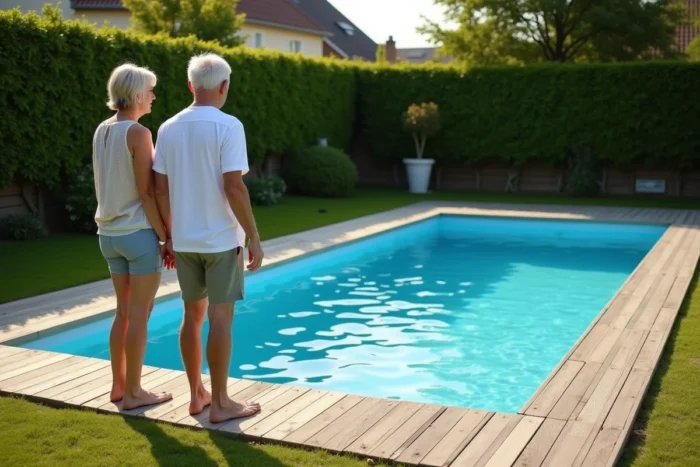
The development tax on swimming pools depends on a central criterion: the surface area of the pool. Choosing the right dimensions can determine whether a project is taxable or not. However, the often-cited threshold of 10 m² deserves closer examination, as several additional parameters can alter the tax situation, even for a small pool.
Surface thresholds and administrative obligations: the reference table
| Pool Surface Area | Prior Declaration | Building Permit | Development Tax |
|---|---|---|---|
| Less than 10 m² | No (except in protected areas) | No | No |
| From 10 m² to 100 m² | Yes | No | Yes |
| More than 100 m² | No | Yes | Yes |
This table summarizes the general rule. Below 10 m², no work declaration is required and the development tax does not apply. As soon as the surface reaches or exceeds 10 m², a prior declaration of work becomes mandatory, and the development tax is due.
To understand the pool size to avoid paying tax, it is important to remember that it is the surface area of the pool itself that counts, measured at the inner level of the walls.
Beyond 100 m², a building permit replaces the prior declaration. The amount of the development tax is then calculated based on the total surface area of the pool, according to a fixed annual value multiplied by the municipal and departmental rates.
Pool of less than 10 m²: why the threshold is not a guarantee
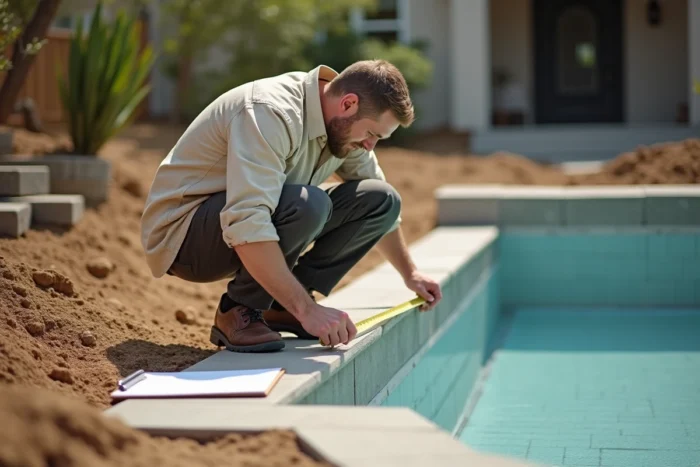
Staying under 10 m² seems like the most straightforward solution to avoid any taxation. In practice, this threshold becomes fragile as soon as the installation takes on a permanent character.
An above-ground pool can be reclassified as a permanent structure if it remains in place for more than three months a year or if it is accompanied by fixed installations. A masonry deck, a permanent technical room, or a ground-fixed shelter is enough to change the classification of the pool.
Boursorama specifies that this reclassification is not a theoretical scenario: urban planning services apply it concretely during inspections. Aerial imagery detection, increasingly used by the tax administration, identifies both large pools and small pools accompanied by visible installations.
Criteria triggering a tax reclassification
- The pool remains installed for more than three consecutive months in the year, even if it is theoretically removable
- Masonry work (deck, sealed coping, retaining wall) surrounds the pool and makes it difficult to relocate
- A fixed or semi-fixed pool shelter covers the pool, creating a closed and covered surface subject to the development tax based on its own dimensions
- A permanently built technical room (excluding removable boxes) accompanies the installation
The logic of the administration is based on the notion of a durable installation. The removable nature of the pool is not sufficient if the built environment contradicts it.
Calculation of the development tax for a pool of 10 m² and more
The development tax on swimming pools uses an annual fixed value set by decree. This value applies per square meter of pool. The final amount then depends on the rates voted by the municipality and the department (and by the region in Île-de-France).
The formula is as follows: pool surface area x fixed value x (municipal rate + departmental rate). Municipal rates vary significantly from one community to another, which means that two identical pools in two neighboring municipalities can generate very different amounts.
The impact of one more or one less square meter
For a modest-sized pool, each additional square meter increases the tax linearly. However, the real tax jump occurs at the threshold of 10 m²: below this, the tax is zero; above this, it applies to the entire surface area.
A pool of 9.5 m² generates no development tax. A pool of 10.5 m² is taxed on its full 10.5 m². There is no exemption on the first square meters.
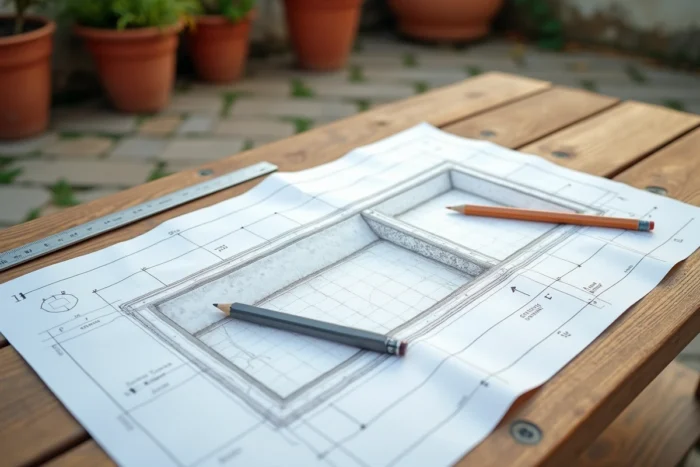
Above-ground, in-ground, or semi-in-ground pool: the impact of construction type on taxation
The type of pool alters the tax exposure, but not in the way many imagine. The distinction does not depend on the material (shell, concrete, liner) but on the degree of anchorage to the ground and the duration of installation.
- Inflatable or tubular above-ground pools installed for less than three months a year are exempt from any declaration obligation and from the development tax, regardless of their surface area
- Kit above-ground pools (wood, steel) installed permanently are treated as fixed constructions and are subject to the same rules as in-ground pools starting from 10 m²
- In-ground and semi-in-ground pools are systematically considered permanent, thus subject to declaration and taxation starting from 10 m²
The container pool, which is becoming increasingly popular, follows the same logic: if it is installed permanently with fixed connections, it is treated as a construction and subject to the development tax beyond 10 m².
Property tax: a distinct impact from the development tax
The development tax is paid only once, at the time of construction. The property tax, on the other hand, increases each year if the pool is considered a built dependency. Any in-ground or semi-in-ground pool increases the cadastral rental value of the property, which permanently affects the property tax.
Removable above-ground pools, installed temporarily, generally do not affect either the property tax or the development tax. The criterion remains the same: the durability of the installation.
Keeping the size of your pool under 10 m² remains the only reliable method to escape the development tax, provided that the entire installation retains a genuinely temporary or removable character. A pool of 8 or 9 m² surrounded by fixed masonry loses this advantage. The surface area of the pool is the entry criterion, but it is the nature of the peripheral installations that determines the actual tax treatment of the project.